Fragmentation in Operating System
Fragmentation in an operating system refers to a condition in which available main memory exists, but it cannot be used efficiently to satisfy process requirements. This problem arises because memory gets divided into many small portions over time, making it difficult to allocate a large continuous block when needed.
As programs are loaded into memory and later removed after execution, the memory space does not remain perfectly organized. Instead, gaps are created between allocated regions. Although the total free memory may be sufficient, its scattered nature prevents optimal utilization, leading to wastage of valuable system resources.
Fragmentation negatively impacts system performance by increasing memory allocation time and limiting the number of processes that can reside in memory simultaneously. The operating system must spend additional effort searching for suitable memory blocks, which can slow down execution and reduce overall efficiency.
This issue is especially common in systems that rely on dynamic memory allocation, where process sizes vary and memory is frequently allocated and released. Without proper memory management strategies, fragmentation gradually increases, reducing the effectiveness of available memory.
Understanding fragmentation is important because it highlights the need for efficient memory allocation techniques. Modern operating systems use various methods such as paging, segmentation, and memory compaction to minimize fragmentation and ensure that memory is used in the most effective way possible.
Types of Fragmentation
1. Internal Fragmentation
Internal fragmentation occurs when a process is allocated a fixed-size block of memory that is larger than the actual amount of memory it needs. As a result, some portion of the allocated memory remains unused within that block. Even though this unused space exists, it cannot be assigned to any other process, which leads to memory wastage.
This type of fragmentation is commonly seen in memory management schemes that use fixed partitioning or fixed-size allocation units, such as paging. Since memory blocks are allocated in predefined sizes, a process that requires slightly less memory than the block size will still occupy the entire block, leaving the remaining space unused.
Over time, internal fragmentation can significantly reduce overall memory efficiency, especially when a large number of small processes are running in the system. Although the wasted memory is technically allocated, it does not contribute to productive processing, thereby limiting the number of processes that can be loaded into memory.
To reduce internal fragmentation, operating systems often use smaller block sizes or more flexible memory allocation techniques. However, smaller blocks may increase management overhead, so a balance must be maintained between efficient memory usage and system performance.

Example: If a process requires 18 KB of memory but is allocated a block of 20 KB, then 2 KB remains unused.
Occurs In: Fixed partitioning, Paging
2. External Fragmentation
External fragmentation occurs when free memory space is divided into many small, non-contiguous blocks as a result of repeated memory allocation and deallocation. Although the operating system may have enough total free memory to satisfy a process request, the memory is scattered across different locations, making it impossible to allocate a single large continuous block.
This problem is commonly observed in systems that use dynamic partitioning, where processes of varying sizes are loaded and removed from memory at different times. As processes terminate, they leave behind gaps in memory. Over time, these gaps become separated by allocated regions, leading to fragmentation of free space.
External fragmentation directly affects system performance because large programs or processes that require contiguous memory cannot be loaded, even when sufficient total memory is available. The operating system may need to delay execution, reject new processes, or attempt memory compaction to overcome this limitation.
To minimize external fragmentation, modern operating systems employ techniques such as paging and segmentation, which allow memory to be allocated in non-contiguous blocks. These approaches improve memory utilization and ensure that available memory can be used more effectively, even in long-running systems.
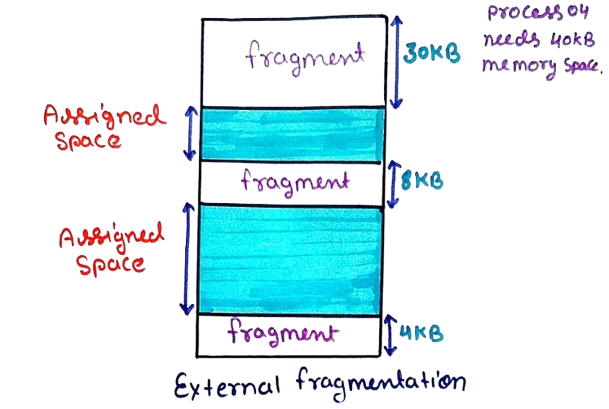
Example: Free memory blocks of 30 KB, 08 KB, and 04 KB exist, but a process needs 40 KB contiguously.
Occurs In: Variable partitioning, Segmentation
Difference Between Internal and External Fragmentation
Internal and external fragmentation are two important memory management problems encountered in operating systems. Although both result in inefficient memory usage, they differ in terms of where memory is wasted, how the problem arises, and the techniques used to handle them. The table below provides a detailed comparison between internal and external fragmentation.
| Feature | Internal Fragmentation | External Fragmentation |
|---|---|---|
| Location of Wasted Space | Memory is wasted inside the allocated memory block. This unused space lies within the boundaries of the block assigned to a process and cannot be shared with other processes. | Memory is wasted between allocated memory blocks. Free memory exists as small gaps scattered throughout the main memory. |
| Primary Cause | Occurs due to fixed-size memory allocation, where processes are assigned blocks larger than their actual memory requirements. | Caused by non-contiguous free memory resulting from frequent allocation and deallocation of processes of varying sizes. |
| Commonly Observed In | Seen in memory management techniques such as paging and fixed partitioning, where memory blocks have predefined sizes. | Observed in techniques like segmentation and variable partitioning, which require contiguous memory allocation. |
| Impact on Memory Utilization | Reduces efficiency by reserving memory that is allocated but partially unused, limiting the number of processes that can reside in memory. | Prevents large processes from being loaded into memory, even when total free memory is sufficient. |
| Possible Solutions | Can be minimized by using smaller block sizes or more flexible allocation strategies to better match process requirements. | Can be reduced using techniques such as memory compaction and paging, which eliminate the need for contiguous memory allocation. |
How to Reduce Fragmentation
- Use Paging to eliminate external fragmentation
- Apply Compaction techniques
- Use Best Fit memory allocation strategy
- Combine Segmentation with Paging
Why Fragmentation is a Problem
- Wastes memory space
- Reduces overall system performance
- Prevents execution of large programs
Exam-Oriented Short Answer
Fragmentation is a condition in an operating system where memory is wasted due to inefficient allocation, resulting in unused memory spaces.